

How To Repair An Existing Deck With Rotton Wood
This article details the steps required to repair decking that has rotted. It is taken from an original commodity written by Steve Smith, and modified to reverberate European construction and materials availability. A sister article exists that explains why decking rots, and how you tin can design decking to resist rot. That article deals with how to build decking to be rot resistant, equally it is very simple to double the life of decking by because how decking rots during design and construction stages. If you take to repair decking that has rotted, then this article is for you.
Repair Decking – or Replace information technology
There comes a bespeak at which restoration is no longer practical and replacement must exist confronted. It is necessary to define the point at which restoration is impractical. This depends on the corporeality of strength which the joist may accept lost and which practical repairs may be expected to return to the construction.
The following recommendations are based on over thirty years of such type repairs past our customers. Nosotros are neither architects nor professional person engineers, and nosotros take no responsibility any for these recommendations. We strongly urge that any structural repair be overseen by a licensed builder or structural engineer equally advisable, and done in full conformance with all building codes and existing regulations.
General Procedure for Repairing Decking
The overall restoration begins with the disassembly of the top of the deck. Each slice of wood which is to exist restored is treated in the prescribed manner, and missing portions of woods replaced with filler. Upon reassembly, a high-adhesion synthetic prophylactic sealant or a layer of Bituthene® is used to make full all the spaces between planks and joists. This prevents the reoccurrence of the kind of deterioration which damaged the deck in the get-go place.
In many cases the owner values the anile, weathered advent of the former deck. It is usually possible to maintain the same appearance by using the same deck planks, and with sufficient artistry in colour matching the filler to the old forest joists the repairs may not appear obvious fifty-fifty from below.
The post-obit procedure is a rough guide for the experienced contractor or the talented apprentice. Remember that every situation is different and there is no substitute for looking and seeing and understanding.
- If the deck planks are screwed down the screw must exist removed from in a higher place. If the deck planks are nailed, the nails may exist removed easily by hit the plank from below with a dead hammer. Once the deck and joist are slightly separated a wedge may exist driven in (below) from the side, or the planks may lift up easily with the expressionless hammer. It is also often feasible to strike the plank from below, lifting information technology up a fleck, and then hit information technology from higher up with the dead hammer. This should be done next to the joist and usually results in the nail standing proud (higher up the plank). The smash may then be pulled out from above with an appropriate tool.
- Number the planks on the edge with a pencil to assist reassembly in the same order on the deck.
- Place the planks upside down on a few sawhorses. Using a wire brush, lightly scrub the surface area where the plank laid on the joist to remove the loose, badly deteriorated forest.
- Soak the entire lesser side of each plank with Clear Penetrating Epoxy Sealer. If it is of import to preserve the weathered appearance of the deck then the planks should be turned over promptly (within mayhap 1/two hour) and solvent-cleaned with Epoxy Clean-upwardly Solvent and rags or paper towels to remove the CPES which has soaked through to the top side. If this is non done earlier the CPES cures in that location will be visible patches of epoxy on the tiptop, which may take many months to atmospheric condition abroad. It is important to retrieve that absolute perfection cannot be attained. Restoration is the art of approaching the original, but a sharp eye may see some evidence that repairs were done.
- Allow the deck planks to dry for at to the lowest degree 48 hours, with the bottom side up. This aids the evaporation of solvents and cure of the CPES.
- Using a wire brush, lightly scrub the top edges of the joists to remove the soft, badly deteriorated wood. Wood soft enough to be scrabbled abroad with the blank fingers should definitely exist removed.
- Soak the height edge of each joist with CPES. Ensure that the woods is completely saturated. Where the nail holes show extensive and prolonged absorption information technology is usually desirable to ream out the deteriorated wood around each nail hole with a one/2″ drill and then go on the impregnation process. Place something nether the joist to catch the CPES runoff (for filtering and recycling) if desired.
- Let at to the lowest degree 48 hours for the solvents to evaporate back out of the wood. In case of severe deterioration where deep impregnation has taken place, ane to two weeks drying fourth dimension may be necessary. As a general rule, when the impregnated areas no longer smell strongly the restoration procedure may exist continued.
- Replace missing wood with Fill up-Information technology epoxy filler. This extremely loftier-quality filter does non shrink or absorb water. It was made originally for underwater repairs on boats. When cured (ordinarily overnight) information technology may be sanded or shaped with normal woodworking tools.
- Sis any joists that may require it. Use essentially clear grain fir with few and minor knots, if any. Utilize Smith'southward Tropical Hardwood Epoxy (it will glue all woods) or 3M 4200 (softer, with better flexibility than 5200) as the glue and bedding sealant between sisters and the original members. Screws or ring-shank nails are preferable to plain nails. Nail or screw the sisters before the adhesive cures, and ensure their top edge is flush with the meridian border of the original joist.
- When the sealant has cured use a abrupt wood chisel or a serrated knife as advisable to remove whatever excess rubber that may have squeezed out on the top edge.
- The deck planks are at present set to exist replaced in their original numbered order. Drill suitable pilot holes for any screws or nails that volition need to get into filler. Identify each plank in its original position, drill the airplane pilot holes, and then take upwardly the plank. Lay a strip of Bituthene® on each joist where the plank rests. 3M 4200 may likewise exist used. Replace the plank and drive the nail or screw through the plank, through the Bituthene® or moisture sealant and into the joist. Boats are repaired in this manner and the life of the repair may be expected to exceed the life of the deck.
Assessing Decking Joist Degradation
Where the underside of deck planks shows deterioration to a depth of a quarter the plank thickness or less, then restoration should be feasible. When the top border of the joist shows deterioration over the full width of the joist and to a depth of perhaps a one-half inch to an inch information technology should be feasible to restore the existing joists. When the top edge of the joist shows deterioration extending through no more than than a quarter of the thickness of the joist it should be possible to restore the existing joist, but it will be necessary to sister a new structural member onto the existing joist.
Repairing Decking Joists – Sistering
Sistering, or the fastening of a new structural member in parallel with an existing weakened i, cannot be done in a piecemeal manner. The new forest and the old woods have different properties and will expand and contract differently. If the repairs are non symmetrical and distributed over the full width of the construction in that location will exist bending, twisting or warping of the deck. Where a 2X12 has astringent deterioration along the upper edge, an appropriate repair would have a two Ten x glued and screwed to the old 2 10 12 on EACH side, flush with the top edge. The structure is symmetrical side-to-side and therefore would not be expected to bend, twist or warp with historic period. The new joist strengthening members (sisters) would run the full length of the deck and extend into the adjoining structure if possible. Since the additional supporting structures span the full width of the deck, ane would not expect the deck to bend or warp as is the case when simply pocket-sized pieces are sistered to a portion of a joist.
Special Materials Required to Repair Rotten Decking
Smiths Clear Penetrating Epoxy Sealer and Fill-It to repair rotten wood.
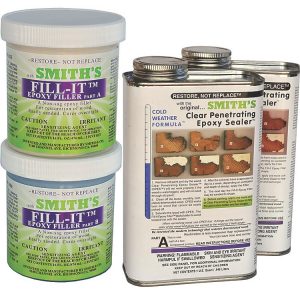
Bituthene to seal gaps.


Source: https://www.makewoodgood.co.uk/how-to-repair-decking/
Posted by: byrdbefer1969.blogspot.com
0 Response to "How To Repair An Existing Deck With Rotton Wood"
Post a Comment